I know I like birds, but what does Zen have to do with that?
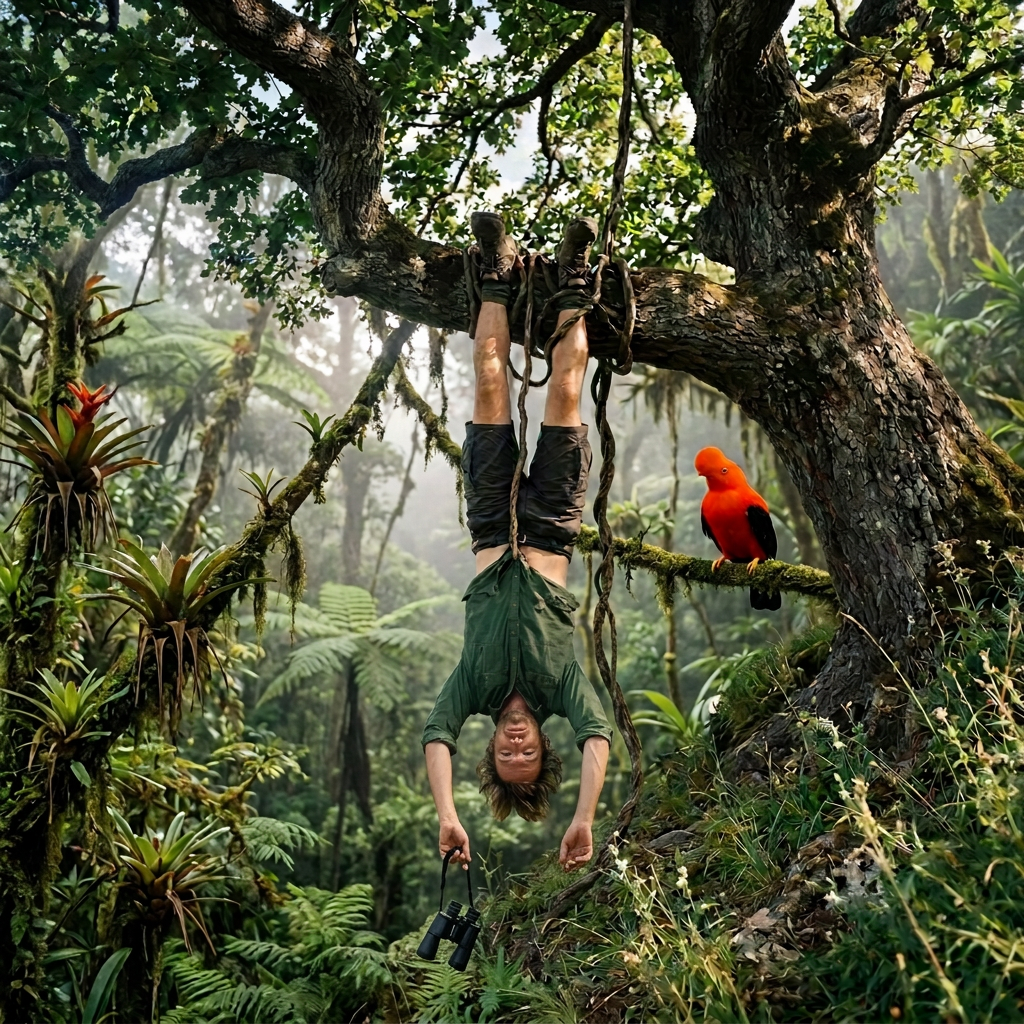
My birding world is literally upside-down. It is dawn. I am in the rain-drenched mountain forests of Ecuador, hanging upside-down and backwards from a tree, my feet entangled in vines, my eyes looking down the sixty degree slope two hundred feet to the bottom of the forested ravine below from which I had recently ascended. I am not in this position by choice. I have fallen. Lady Luck (or God) has provided the vines that spared me by catching my feet as I fell. I have never been more alive.
I just finished observing one of the world’s most fantastically beautiful birds, the Andean Cock-of-the-Rock, a chicken-sized bird that has, at this location, an almost iridescent blood-red body and head, black wings, and a conspicuous bushy frontal crest.
I have unwittingly made these observations from the inside of their lek (the communal location where the males come to offer sexual display in hopes of attracting female attention). Moments before my fall I was within a few feet of ten or more of these absolutely brilliant male birds that were swooping and squawking, landing and leaning, puffing and preening, bowing and keening.
The birds, undisturbed by my presence and focused on the more distant females put me in birding heaven.
And then I fall. In this predicament, I am brought abruptly into an awareness of the here and now. I am not dwelling in the past, resentful over the raise I failed to get last month, or stuck in the future, worried about whether I can meet my mortgage. I am squarely in the great eternal “Right Here, Right Now”, poised at the cusp between past and future. My attention is fully focused on my perilous situation.
A famous Zen Koan speaks metaphorically to these circumstances (A Koan is a short, often-paradoxical vignette used as a vehicle for meditation and spiritual growth.) With some paraphrasing, the Koan says: “A monk finds himself hanging by his teeth from a small branch attached to the side of a cliff-face, his arms tied behind him, his feet similarly bound. The Buddha walks to the edge of the cliff, looks down at the monk, and asks,” Do you need help?”“*
How do monks and birders get themselves into situations such as mine?
“I really love the birds.”
“I could sit and watch them all day.”
“I find so much peace when I am looking at birds.”
“I am so excited when I see a new bird.”
These are the typical responses from beginning birders to the question, “Why do you bird?” Ardent accomplished birders may answer the same question differently.
“It provides me an income.”
“I need a new publication.”
“I want to see all the families of the birds of the world.”
“Only five other people have ever seen that bird.”
Getting below these surface responses, further inquiry reveals answers very similar to those provided by the beginners.
“I just love the birds. I am fascinated by them.”
Love and fascination bring birders to “Right Here, Right Now”. When they get their binoculars on a bird, all thoughts of the past and future evaporate. They are poised at the cusp, hanging from the cliff-face, gloriously not self-aware, not judgmental; they are engrossed with the thrill of existence. They are in a deeply spiritual state.